
What the research actually says about churches and AI
Pastors have already made up their minds about AI, and they have not landed in the same place. Lifeway put the question to 1,003 U.S. Protestant senior pastors and found a room genuinely divided.[1]
That last number is not about what AI can do. It is about what surveyed churchgoers believe a pastor should do. Sixty-one percent of them are concerned about AI's influence on Christianity, and the figure is higher still among those Lifeway counts as evangelical by belief.[2]
Meanwhile the load keeps climbing. In a separate Lifeway study of Evangelical and Black Protestant senior pastors, 67 percent said they feel constantly on call and 57 percent feel frequently overwhelmed. That is pastors describing their own week rather than a clinical finding, and nobody asked them about AI.[3]
The pattern is not only American. NCLS asked senior leaders in Australian local churches, Catholic and Protestant, to name the roles they actually carry and the ones they would choose. Administration came back as a job 42 percent were doing and 30 percent did not want. Training people for ministry ran the other way: about a quarter were doing it and about half wished they were. NCLS publishes no sample size for these figures and did not ask about AI, but the shape will be familiar to anyone on a church staff. The admin grows and the discipleship gets squeezed.[4]
The church needs a tool, not an artificial shepherd
More religious material is not the same thing as kingdom fruit. Christ gives the Great Commission to his church (Matthew 28:18–20), and God gives the growth (1 Corinthians 3:5–9). A model can rearrange words all day. It cannot pray, love a member or answer to Christ for a congregation.
The church does not need an artificial shepherd. It needs faithful shepherds with better tools.
You know a particular flock, and you will give account for their care (1 Peter 5:1–4; Hebrews 13:17). You handle the Word among people whose names you know (2 Timothy 4:1–5). The evangelical statements reach the same practical boundary: AI may assist, but people remain responsible. Lifeway says it cannot replace study, teaching, counseling, mentoring or discipleship.[5] The ERLC keeps moral agency with people,[6] and Lausanne says the time you save should go back to people and mission.[7]
Moore Theological College makes the practical point: AI may suggest study questions, but fluent answers can still be invented.[8] Acts 6 is the pattern worth copying. Organizing the work protected prayer and the ministry of the Word, and the work itself went to seven men full of the Spirit and wisdom, chosen by the congregation. AI is not a deacon. The Southern Baptist Convention likewise calls for honest, transparent use without intentional deception.[9]
The people you pastor are already asking AI about faith and Scripture
While church leaders debate policy, the people in the pews are already typing questions into a chatbot at eleven at night. Barna found 48 percent of practicing Christians would trust AI with spiritual growth, and 34 percent said its spiritual guidance could be as trustworthy as a pastor's.[10] About a third had used AI for spiritual guidance or Bible questions in the previous month.[11]
Pastors can see the risk. Among U.S. Protestant pastors, 94 percent worried that AI could misinterpret Scripture. And on genuinely contested passages, 60 percent wanted the major views laid out without a verdict, while only 10 percent wanted AI to name the correct view.[12] That is worth sitting with. Pastors are not asking a machine to be right about theology. They are asking it to stop pretending it can be.
So help your congregation use it wisely rather than hoping they will not use it. Read the passage in context. Trace where the answer came from. Hold it against your church's confession and your trusted teachers. Bring the serious questions back into the room with other Christians. A chatbot can surface a good question. It is not a spiritual authority.

12 practical uses of AI in church ministry
The safe ones all look the same: known facts going in, nothing confidential, and a result somebody can actually check. Anything touching doctrine, care, privacy or public authority needs a heavier hand on the wheel.
Set the terms before buying the tool
- Write a one-page church AI policy. Name permitted tools, prohibited information, review and disclosure. In a Barna and Pushpay network sample, 64 percent said a policy mattered; 5 percent had one.[13] That was one network's sample rather than a national count, but the gap is the point.
- Decide where saved time will go. Return time from formatting to study, prayer, visitation, mentoring or local mission. Otherwise the church may simply make more material and stay rushed.
Strengthen the work around the sermon
- Use AI as a research scout. Surface claims to check, views to compare and original sources. Then read them. A confident paragraph is not evidence.
- Organize the pastor's own notes. Group observations, trace a repeated theme or flag a gap. Do not let it add an illustration, application or conclusion and present that as the pastor's.
- Prepare ministry material after the message is settled. Once approved, AI can draft questions, lesson aids and a slide outline. The pastor or ministry leader checks every addition.
Reduce the repeat work
- Draft routine communication from confirmed facts. Turn an event brief into an email, bulletin item or reminder. Check every date, name, promise and link before sending.
- Turn non-confidential meetings into actions. Format ordinary notes into decisions, owners and deadlines. Keep counseling, giving, health and safeguarding details out of general AI tools.
- Capture repeatable church processes. Draft an opening checklist, communion setup or handover from the team's real process. The person who does the work corrects it.
Give people a checked starting point
- Adapt approved teaching for a group. Simplify vocabulary or reshape an exercise without changing doctrine or inventing details. A suitable leader checks theology and age fit.
- Draft small-group questions from the finished sermon. Ask for questions tied to the actual text and message. The leader removes anything forced, vague or intrusive.
- Prepare volunteer training material. A ministry leader can turn a church process into a short guide or practice scenario. Church policy and safeguarding instructions outrank generated answers.
- Translate routine material, with a fluent person checking. AI can draft an announcement or simple guide. Never use an unchecked translation for doctrine, crisis care, consent or safety instructions.
The ministry handoff test
Use the checker before AI touches a church task. Privacy stops the handoff, authority stays human, and only known, checkable work may be drafted.
Should this task go to AI?
Answer three plain questions. Stop as soon as the boundary is clear.
Does it contain personal or sensitive information?
Start with the privacy question.
What a church AI policy needs beyond “do not paste private data”
Where your church stands legally depends on your country, and in some places on your size and activities too. Treat the frameworks below as shapes worth copying rather than as your rules, and check what actually applies where you are.
- United States
- NIST AI Risk Management Framework. Four jobs: govern, map, measure and manage. Voluntary, and the clearest plain structure a small team can borrow.[14]
- United Kingdom
- ICO guidance on AI. Existing data protection law already applies. It expects a documented lawful basis, human involvement that is real rather than a rubber stamp, and an impact assessment for high-risk uses.[15]
- Australia
- National AI Centre and the OAIC. An AI register, an incident process, monitoring and human override,[16] plus checks on vendor training, data location, access and review. Religious belief counts as sensitive information,[17] and Privacy Act coverage varies with a charity's turnover and activities.[18]
Wherever you are, the practical core is the same. Keep a simple list of every AI tool your church uses. Require a person to approve anything a tool can send, publish or change. Plan for pastor impersonation, donation fraud and misuse of people's photos, because deepfakes damage identity and reputation.[19] And remember that generating an image does not hand you rights to whatever it reproduced. Check the licence, permission or exception that applies in your country.[20]
Who can use AI for what?
- Routine drafts
- AI may prepare it; a person checks it before use.
- High-consequence support
- AI may assist; a qualified leader verifies and decides.
- Human-only or private
- Do not delegate it or enter it into general AI.
Every AI-produced result has a named person responsible for it.
Showing all 9 ministry decisions for all roles.
Showing 3 examples first. Open 6 more, or choose a role.
| Ministry work | AI boundary | Who checks it |
|---|---|---|
| Draft a one-page church AI policy | High-consequence supportChurch leadership sets and approves the rules. | Senior pastor, elders or governing board |
| Find research questions and original sources | High-consequence supportRead the sources and test every claim before teaching it. | Teaching pastor |
| Organize the pastor’s existing notes | Routine draftsThe pastor decides what stays. | Pastor |
| Draft a routine message from approved facts | Routine draftsCheck names, dates, promises and tone before sending. | Administrator |
| Turn non-confidential meeting notes into action items | Routine draftsConfirm decisions, owners and dates against the notes. | Ministry staff member |
| Prepare a volunteer checklist from an approved process | Routine draftsA ministry leader approves every instruction. | Volunteer coordinator or ministry leader |
| Adapt approved teaching for an age or group | High-consequence supportCheck doctrine, age fit, language and safeguarding. | Pastor or ministry leader |
| Make the final interpretation or public teaching decision | Human-only or privateThe accountable pastor or elder decides. | Accountable pastor or elder |
| Handle counseling, discipline, safeguarding or confidential member data | Human-only or privateKeep care human and private data out of general AI. | Qualified, accountable people under church policy |
Draft a one-page church AI policy
- AI boundary
- High-consequence supportChurch leadership sets and approves the rules.
- Who checks it
- Senior pastor, elders or governing board
Draft a routine message from approved facts
- AI boundary
- Routine draftsCheck names, dates, promises and tone before sending.
- Who checks it
- Administrator
Handle counseling, discipline, safeguarding or confidential member data
- AI boundary
- Human-only or privateKeep care human and private data out of general AI.
- Who checks it
- Qualified, accountable people under church policy
Show 6 more ministry decisions
Find research questions and original sources
- AI boundary
- High-consequence supportRead the sources and test every claim before teaching it.
- Who checks it
- Teaching pastor
Organize the pastor’s existing notes
- AI boundary
- Routine draftsThe pastor decides what stays.
- Who checks it
- Pastor
Turn non-confidential meeting notes into action items
- AI boundary
- Routine draftsConfirm decisions, owners and dates against the notes.
- Who checks it
- Ministry staff member
Prepare a volunteer checklist from an approved process
- AI boundary
- Routine draftsA ministry leader approves every instruction.
- Who checks it
- Volunteer coordinator or ministry leader
Adapt approved teaching for an age or group
- AI boundary
- High-consequence supportCheck doctrine, age fit, language and safeguarding.
- Who checks it
- Pastor or ministry leader
Make the final interpretation or public teaching decision
- AI boundary
- Human-only or privateThe accountable pastor or elder decides.
- Who checks it
- Accountable pastor or elder
Good software should make that last column easier, not harder. Pastorly labels every line it produces as either the pastor's own material or something it added, so the person who has to check it can see which is which.
A four-stage path to adopting AI in your church
Do not start with sermon writing, counseling notes or the membership database. Start with one ordinary, non-confidential task that one person can read line by line before anyone relies on it. If that goes well, take the next step. If it does not, you have lost a week and nothing else.
Move one stage at a time
Set the boundaryWrite down what may be drafted, what a leader must decide and what stays private.
What to doName the approved tools and the person who checks every output.
Stop here ifStop if the task needs member, counseling, children’s or safeguarding data.
Choose one routine taskStart with approved, non-confidential material and keep the first pilot small.
What to doTry an event email, volunteer checklist or questions from an approved sermon.
Stop here ifStop if the pilot drifts into sermon authorship or personal care.
Name the reviewerPut one accountable person on the result before the church relies on it.
What to doThat person checks Scripture, facts, theology, tone and copyright before use.
Stop here ifStop if nobody can say, “I read this and I own the decision.”
Give the time backMeasure the time returned to prayer, people and mission.
What to doAsk what became clearer, what needed repair and where the saved time went.
Stop here ifStop if AI only helps the church produce more material.
Stage three is the one Pastorly is aimed at. It marks the claims it can actually check and says plainly which ones the reviewer still has to settle before Sunday.
How Pastorly helps the week around a sermon
Everything above works with the tools a church already has. Turning one sermon into Sunday School, youth and small-group material sets out a worked method for that handoff.
Pastorly keeps that one sermon connected to the slides and the group material across the week. It is not a church management system, a membership database or a substitute for pastoral care, and the build is still private while we finish it.
Two numbers from earlier in this guide shaped how it works. Eighty-four percent of pastors said AI output should be edited on the assumption it contains errors, and 60 percent said that on contested passages they want the major views laid out instead of a verdict. Both are built into the product rather than argued with.
What the current private build is designed to do
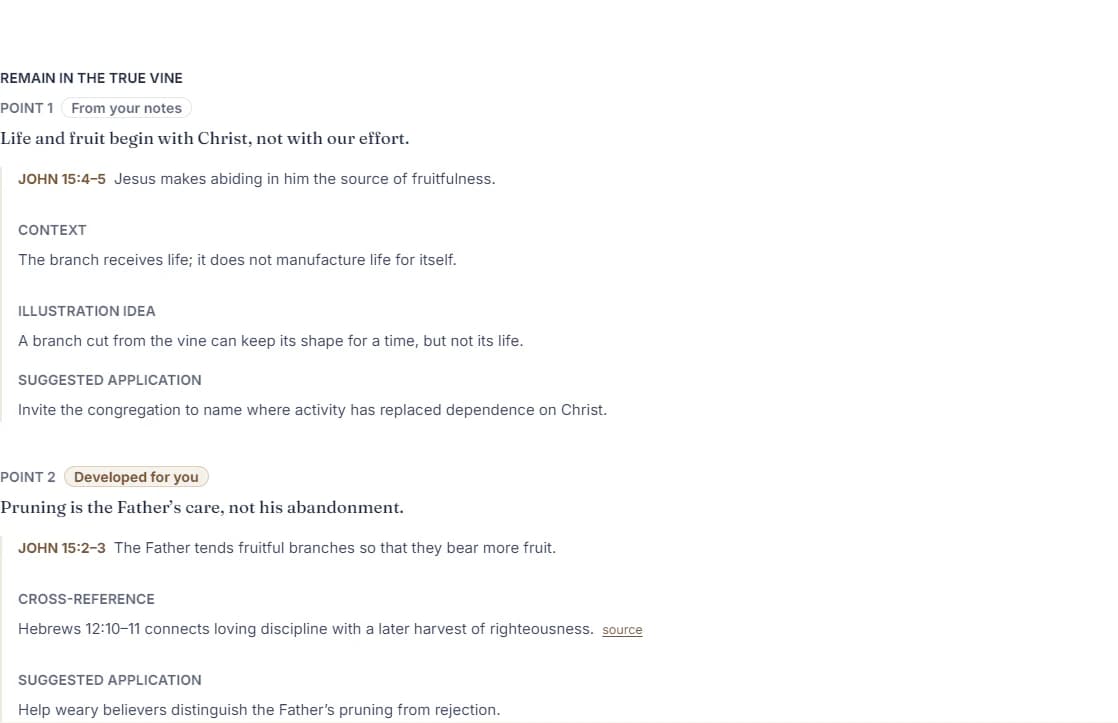
- Start from the pastor's material. An outline, a manuscript, bullet points or rough notes stay the source. Where the notes are genuinely unclear, Pastorly says so and marks it “Needs your eye” rather than filling the gap with something invented.
- Show what came from where. Every line carries its own label: “From your notes” for the pastor's own material, “Developed for you” for anything Pastorly added. You can see the seam at a glance rather than hunting for it.
- Flag what still needs checking. A claim that can actually be settled gets marked as supported by the sources, or as one to verify before preaching, or as disputed by them. Dates, attributions and historical claims are checkable. Theology is not, so Pastorly does not pretend to rule on it.
- Keep the research beside the note. Aide researches while you work and shows the links it found. Ask Aide to check something, or run a check over a whole note, and Aide goes to sources and says plainly when they disagree. The pastor reads and decides.
- Carry the approved message into the week. Once the sermon is settled, Pastorly can prepare editable slides and group material under the pastor's control.
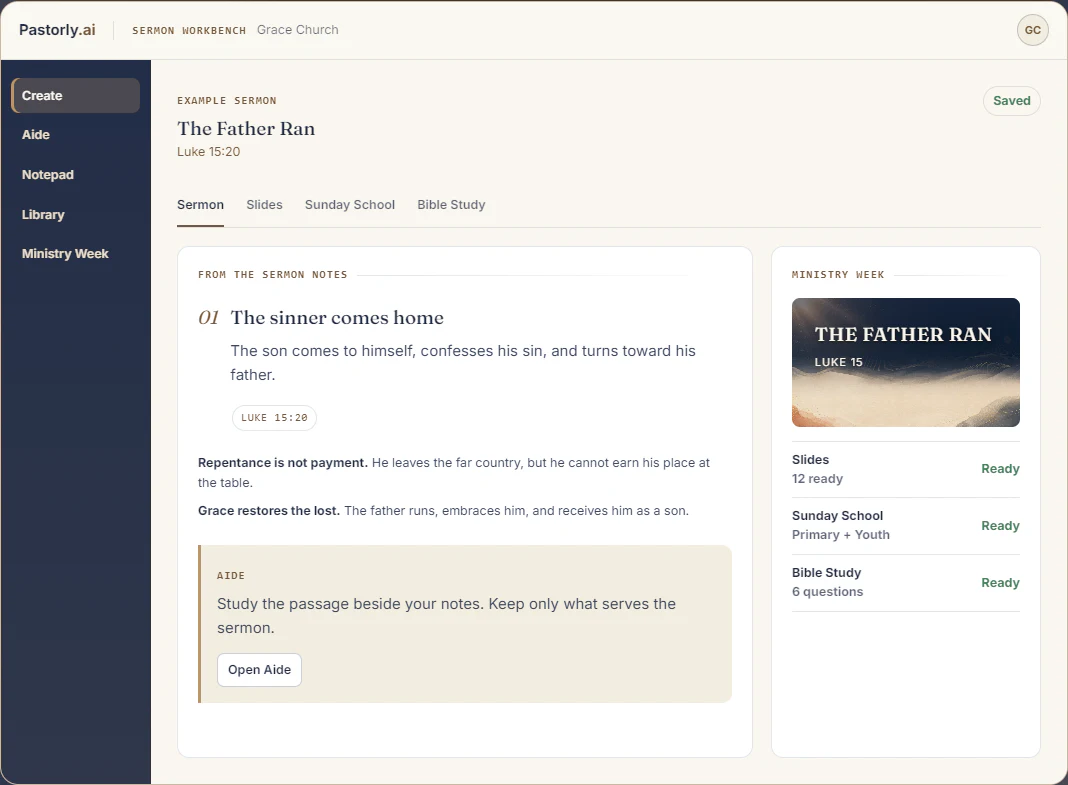
The goal is less repeated work, not a more mechanical church. Scripture, theology and the final call stay exactly where they belong. Read how Pastorly handles sermons, Aide, sources and data.
Common questions about AI for churches
Should pastors use AI to write sermons?
Not to write them. Do not hand over Scripture, your knowledge of the congregation, or ownership of what gets preached. AI can organize your notes and it can point you at sources, but its words are not your study and not your experience.
Is it wrong for a pastor to use AI?
Scripture does not speak to the tool, so this is a question of stewardship and honesty rather than a rule. Using AI to format a bulletin is not a moral event. Passing off generated study, insight or care as your own is. The boundary the evangelical statements land on is that AI may assist, and a person remains responsible.
How can staff and volunteers use AI responsibly?
Give them three things: confirmed facts, one narrow task, and a named person who reads the result. Notices and checklists are much safer ground than doctrine, care or policy.
What church data should stay out of general AI tools?
Counseling notes, prayer requests, children's information, giving records, health details, disputes and anything safeguarding. Be careful with the nameless story too, because in a congregation of two hundred people it is rarely as nameless as you think.
Can AI replace pastoral care?
No. It cannot know a person, pray in faith, or sit with someone in the worst week of their life. Care and judgment stay human.
Should a church tell people when it uses AI?
Say so wherever a person could reasonably feel misled: teaching, a pastoral message, or an image of your own people. Nobody needs a disclosure on a roster reminder. Write the rule down once so it is not decided differently every week.
Does a church need an AI policy?
Yes, and one page is enough to start. Name the permitted tools, the data that never goes in, who reviews output, when you disclose it, and who is responsible when something goes wrong.
Sources
- Lifeway Research, Pastors' Views on Artificial Intelligence
Phone survey of 1,003 U.S. Protestant senior pastors; random, weighted church sample; error ±3.3 points.
- Lifeway Research, Protestant Churchgoer Views on Artificial Intelligence
Online survey of 1,200 monthly U.S. Protestant and non-denominational churchgoers; error ±3.2 points. The 44/43 item asked about seeing “nothing wrong” with AI-assisted sermon preparation.
- Lifeway Research, Pastor Attrition Study 2025
Mixed-mode survey of 1,516 Evangelical and Black Protestant senior pastors; error ±2.7 points. Self-reports, not a burnout diagnosis.
- NCLS Research, Ministry roles: What should be done versus the actual reality and Gap between aspiration and actually developing new leaders
Respondents selected up to three actual roles and three desired roles. The findings cover senior local leaders in participating Australian Catholic and Protestant churches; no sample or weighting is published for these estimates.
- Lifeway Christian Resources, Brentwood Statement on Artificial Intelligence and Christian Ministry, June 2026
- Ethics & Religious Liberty Commission, Artificial Intelligence: An Evangelical Statement of Principles, 11 April 2019
- Todd Korpi, Lausanne Movement, AI Use in the Church, October 2025
Used for its ministry framework, not as survey evidence.
- Centre for Christian Living at Moore Theological College, God, Artificial Intelligence and You, 20 July 2024
- Southern Baptist Convention, On Artificial Intelligence and Emerging Technologies, 15 June 2023
- Barna Group, AI is Becoming a Spiritual Authority, Even Among Practicing Christians, 19 May 2026
Online U.S. adult survey, n=1,514; the practicing-Christian subgroup size is not public.
- Barna Group, New Barna Data: Practicing Christians are Adopting AI Rapidly, 21 July 2026
The practicing-Christian subgroup size is not public.
- Barna Group, How AI Is Shaping Bible Interpretation, 25 August 2026
Online survey of 442 U.S. Protestant pastors in December 2025.
- Pushpay with Barna Group, The State of Church Technology 2026, with Barna's companion findings and method page
Its 1,306 U.S. leaders came from Barna and Pushpay networks, so results are directional, not nationally representative.
- U.S. National Institute of Standards and Technology, AI Risk Management Framework (AI RMF 1.0) and Playbook
Voluntary guidance built on four functions: govern, map, measure and manage. Not law, and NIST lists AI RMF 1.0 as under revision.
- UK Information Commissioner's Office, Guidance on AI and data protection
Non-statutory guidance on how UK data protection law applies to AI. The ICO notes the guidance is under review following the Data (Use and Access) Act.
- Australian Government National AI Centre, Guidance for AI Adoption Foundations
Operational guidance, not new law.
- Office of the Australian Information Commissioner, Guidance on privacy and the use of commercially available AI products
- Office of the Australian Information Commissioner, Privacy for not-for-profits, including charities
Turnover and activity-based Privacy Act coverage.
- Australian eSafety Commissioner, Deepfakes
Cited for the harm pattern, which is not country-specific. The church impersonation rule above is this article's recommendation.
- Australian Government Attorney-General's Department, For copyright users
Guidance on permission, exceptions and licences. Copyright rules and exceptions differ by country, so check your own.