

The sermon is preached once. The preparation is not.
Sending the sermon manuscript does not finish the weekly teaching handoff. The Sunday School teacher still needs a lesson. The youth leader needs questions teenagers can work through. The small-group leader needs a guide that makes sense to someone who missed Sunday.
Without that preparation, each leader has to find the central point, decide what to leave out, supply examples and work out what the group should do next. You have shared the sermon and handed each leader most of the preparation with it.
First agree on the biblical centre and essential reasoning. Then adapt the language, activities, questions and application for each group. Mark additions and unresolved questions, review meaning and teachability separately, and hand over an approved version with time for leaders to prepare.
The goal is not the same lesson in three rooms. It is one faithful biblical centre taught appropriately in each.
- Sunday SchoolAge-fit language and activity
- Youth groupMotives, objections and choices
- Small groupText-grounded discussion
Start with a message brief, not a shorter manuscript
Before producing lessons, write a one-page brief that another leader can understand without reconstructing the sermon.
State what the passage teaches, how the sermon reaches that conclusion and why listeners should respond. A topic such as “forgiveness” is not enough. Neither is a slogan that leaves out the passage’s reasoning.
Use the brief to distinguish a settled teaching point from a possible illustration, a tentative interpretation or a note you have not finished thinking through. A question mark in your notes must not become a confident sentence in somebody else’s lesson.
Ask the pastor to approve this brief before adaptation. Approval means, “This accurately represents what we intend to teach,” not, “This cannot be questioned.”
Scripture remains above the sermon. When preparing the brief exposes an error or an unsupported inference, correct the sermon and its related material.
Preserving the message is not a reason to preserve a mistake. The brief is a review surface, not a permanent ruling.
What stays the same, and what changes?
Preserve the meaning and the reasoning that connects it to the passage. Give leaders freedom over how their group encounters that meaning.
Preserve the meaning. Adapt the encounter.
| What stays faithful | What can change for the room |
|---|---|
| The passage and its relevant context | Reading aloud, supported reading or shorter sections with explanation |
| The approved teaching centre | Vocabulary and sentence length |
| The essential reasoning connecting text and teaching | The order of explanation, discovery and discussion |
| Necessary qualifications and limits | Examples, scenarios and activities |
| The biblical reason for responding | A concrete response appropriate to age and circumstances |
| The distinction between Scripture, explanation and illustration | Session length, pacing and leader prompts |
An illustration can go. A necessary qualification cannot disappear merely because it makes a worksheet longer.
A shorter session may explore one part of the passage in greater depth. It should explain how that part fits the whole rather than quietly replacing the sermon’s centre with an easier theme.
Define the actual room before drafting: ages, reading confidence, familiarity with Scripture, available time, leader experience and any participation needs. “Sunday School” can describe an adult class as well as children’s teaching. “Small group” describes a setting, not an age.
A practitioner account from Youthworks describes one church using the same passage and central teaching across its children’s settings. The presentation differed, and each session stood on its own for children who did not attend every meeting. It is a useful example of alignment, not general causal evidence or a promise of results.
A fictional worked example: Ephesians 4:25–32
The following is a fictional teaching example, not a customer story or a report of a church’s results. Its scenarios and lesson wording are proposed adaptations for human review.
The passage follows the contrast between the old and new life in verses 17–24. Paul addresses how believers treat one another, tells them not to grieve the Holy Spirit, and grounds forgiveness in God’s forgiveness of them in Christ.
Copy the headings below for your own sermon. Here they are filled in, so you can see the decisions a reviewer needs.
One-page message brief
One page a ministry leader can work from without reconstructing the sermon. Every field below is a decision a reviewer needs to see.
Teaching summaries throughout, not Scripture quotations- Passage and context
- Ephesians 4:25–32. These instructions follow the call to put off the old life and put on the new in 4:17–24.
- Approved teaching centre
- In response to God’s forgiveness in Christ, believers are to replace harmful speech and bitterness with words and conduct that help others.
- Supporting movements
- Verses 25–28: truth instead of lying, anger without sin, work and generosity instead of stealing. Verses 29–30: words that help others, without grieving the Holy Spirit. Verses 31–32: bitterness and malice replaced by kindness and forgiveness.
- Intended response
- Turn from a specific harmful pattern and practise a truthful, generous or forgiving alternative, in response to God’s forgiveness rather than to earn it.
- What must not be lost
- God’s forgiveness in Christ; responsibility towards others; actual changes in conduct, not merely nicer-sounding words.
- What must not be implied
- Kindness earns salvation or popularity. Truth must be concealed to avoid disagreement. Forgiveness requires ignoring harm or resuming unsafe contact.
- Additional material requiring review
- Playground and group-chat scenarios, proposed applications and simplified explanations. These are additions, not quotations from Scripture.
- Unresolved items
- The rough note “forgive = forget?” needs clarification. Exclude it from teaching material until resolved.
- Approved version and reviewer
- Illustrative draft v1.0. Before use, record the approving pastor and date, then the ministry leader’s review and the final version.
The centre deliberately includes conduct, not only speech. Verse 28 concerns work and sharing with someone in need. An adaptation about “using kind words” alone could lose that part of the passage.
Keep the source visible during drafting. Suppose the fictional notes say, “v29: words should fit the hearer’s need.” A playground scenario can illustrate that point, but it is newly developed material. Label it as developed material in the review copy.
The unfinished “forgive = forget?” note requires clarification, not a polished explanation of what the pastor supposedly meant.
- 01ChildrenThe room brings
Picture or sentence cards
Participants work throughHarmful responses and helpful replacements
- 02TeenagersThe room brings
A fictional group chat
Participants work throughApproval, motives and another person’s good
- 03AdultsThe room brings
A fictional workplace mistake
Participants work throughTruthfulness, helpful speech and conduct
Three rooms, one centre
The message brief gives every leader a starting point. The session still has to belong to the room. Each example below is self-contained for someone who did not hear the sermon.
Children’s Sunday School
Children can identify a harmful response, suggest a helpful replacement and explain that Paul gives these instructions to people God has forgiven through Jesus.
- First 5 min
Introduce a fictional situation. During a game, one child makes a mistake and another laughs. Ask, “What could someone say or do that would help?” Keep names invented and do not ask children to identify classmates.
- Next 10 min
Read the passage in short sections. Draw two columns: “Put away” and “Put in its place.” Add lying and truth; stealing and working to share; harmful words and helpful words; bitterness and kindness. Explain that telling a trusted adult about harm is not the same as speaking maliciously.
- Next 10 min
Practise replacements with picture or sentence cards: someone is left out; someone has taken a pencil; someone is mocked after a mistake. Children can suggest spoken, drawn or pointed responses.
- Final 5 min
Ask, “Why does Paul tell Jesus’ people to forgive?” Invite children to choose one helpful action to practise. Pray for God’s help without requiring public confessions.
Teenage youth group
Teenagers examine motives and choices from Scripture rather than repeating an adult talk with slang added.
- First 5 min
Consider a fictional group chat. Someone posts an embarrassing photo. A friend writes, “Relax, it’s only a joke.” Nobody needs to open a phone or show a real conversation. Ask, “What makes it difficult to disagree with the group?”
- Next 10 min
Read Ephesians 4:25–32. Have teenagers identify harmful patterns and their replacements. Ask what reasons Paul gives for change, including belonging to one another and forgiveness in Christ.
- Next 15 min
Compare joining in, staying silent, challenging the post and seeking help where harm is involved. Ask which responses protect popularity, which seek the other person’s good, and how verse 32 gives a different reason for acting than keeping everyone’s approval.
- Final 10 min
Invite private reflection on a speech habit and an optional discussion of a practical alternative. No one has to name a person or describe an incident. Pray.
Adult small group
Adults follow Paul’s reasoning from the text and discuss how truthfulness, useful speech and conduct serve another person’s good.
- First 10 min
Give a two-sentence summary of the context and read Ephesians 4:25–32 together. Ask people to notice both commands and reasons.
- Next 25 min
Ask what Paul tells believers to stop and what must take its place, what reasons he gives, and how another person’s needs shape both speech and conduct. Keep leader notes pointing to verses 25, 28 and 29–32.
- Next 15 min
Offer a fictional workplace situation: a colleague has made an expensive mistake, and others are discussing it. Ask how truthfulness, useful speech and generosity might shape a response without hiding the mistake.
- Final 10 min
Invite each person to identify a response privately. Make sharing voluntary. Prayer should not require recounting someone else’s wrongdoing.
The three rooms do not need different visual themes, cartoon age icons or a ranking of spiritual value. The content creates the variation: cards for children, a group-chat dilemma for youth, and a workplace discussion for adults.
The failed adaptation: “Be nice so people will like you”
This sounds suitable for children. It also changes the message. The action is reduced to being pleasant, and the reason becomes gaining approval. God’s forgiveness in Christ disappears. So does the possibility that truthful, helpful conduct may be unpopular.
“Be nice so people will like you.”
Nothing here is false. It is simply a different message, with a different reason for obeying it.
“God has forgiven his people through Jesus. He calls them to put away hurtful words and bitterness, and to speak and act for others’ good.”
This is simplified teaching language, not a Bible quotation. It preserves the reason for responding while leaving room to explain what truthful kindness looks like.
Review twice: meaning first, then teachability
A resource can reflect the sermon accurately and still be difficult to teach. It can also be engaging while teaching something different. Review both.
Accurate is not the same as teachable.
The two questions have different answers, different evidence and different people best placed to answer them.
- 01Meaning and fidelity
Compare the adaptation with Scripture and the approved brief.
The pastor or designated theological reviewer checks the teaching centre, essential reasoning, qualifications, cross-references and every new application. Resolve disagreement against Scripture.
- 02Teachability and safeguarding
Read it with the actual group in mind.
The ministry leader checks vocabulary, timing, participation, materials and invitations to share. Personal disclosure stays optional. Follow the church’s safeguarding procedure when a concern arises.
If a question fails, return the draft to the relevant reviewer. The visual shows a handoff, not an automated repair loop.
Keep disagreement visible. When a ministry leader questions an interpretation, resolve it against Scripture rather than treating the approved document as unchangeable. Remove unresolved teaching claims or give leaders a clear instruction not to teach them yet.
Keep invitations to share voluntary. Do not pressure anyone to disclose abuse, sexual experiences, family conflict or their worst sins. Use hypothetical situations where appropriate. If a concern or disclosure arises, leaders should follow their church’s safeguarding procedures rather than investigate it in the group.
Labels help reviewers see where material came from. They do not prove that either the original notes or the additions are correct.
Make the handoff fit the week
Agree on a delivery point that gives leaders time to read, ask questions and gather materials. A group meeting on Tuesday needs the material well before Tuesday, and the person who sends it has to be named rather than assumed.

Give leaders time to read, ask and prepare.
- 01FridayAgree the brief and prepare draft guides.Pastor and ministry leader
- 02SundayCheck changes after preaching.Pastor
- 03MondaySend reviewed copies.Named coordinator
- 04Tuesday or WednesdayLeaders use the material.Ministry leaders
- 05After the sessionGather feedback for the next guide.Leader and coordinator
Move the sequence earlier or work a week behind when leaders need more notice. The pastor takes responsibility for the meaning review; the ministry leader checks the session; a named person sends the final copies.
Send the brief alongside a clean leader guide containing the passage, session aim, timings, materials, main questions, optional prompts and safeguarding notes. Distinguish essential sections from material the leader can leave out.
Include the version, approval date and contact for questions. After a meaningful sermon revision, check affected resources again and tell leaders exactly what changed. Do not assume an updated source has reached every printed or saved copy.
Sermon-linked material is an option within a church’s wider teaching plan. It is not a replacement for a sequenced curriculum or a requirement that every ministry follow the sermon every week. SmallGroups.com’s discussion of sermon-based curriculum weighs the benefits of a shared focus against the planning and production work for staff and volunteers, and the need for flexibility. Choose sermon-linked sessions where they serve the group, not merely because the sermon is available. Where that production work already falls to the same few people, our guide to the work a Sunday roster does not record is the question to settle first.
A last read before it leaves your hands
Use the following as a final working check. After the session, ask the leader what needed explaining, what they skipped and whether any question led somewhere unintended. Use that feedback to improve the next guide.
Before you send the material
Mark a line as you check it. Nothing is saved, scored or sent.
Where Pastorly fits
You can use this method with a shared document. Pastorly keeps the source sermon and the teaching material built from it in one place.
A pastor starts with rough notes or a manuscript, reviews the message and outline, and uses that approved work to prepare editable slides, Sunday School, youth, Bible Study and small-group material. The Pastorly home page describes that connected week, and the FAQ explains how the pastor stays in control of each step.
Pastorly’s “From your notes” and “Developed for you” labels distinguish material that began with the pastor from material developed beyond those notes. The labels make that development visible rather than presenting it as the pastor’s original writing.
Continuity you can inspect
Unclear material can be left for review with a visible “Needs your eye” note. At that clarification step, Aide helps you examine the passage and sources beside your notes. The pastor reads and decides.
Source labels tell you where material came from. They do not establish whether it is correct or replace either review.
Read how Pastorly handles sermons and sources.One sermon, still yours
The question Pastorly sets out to answer is narrow: as the sermon travels through the week, can the source, the developed material and the reviews stay together, where a leader can inspect them?
Pastorly is in private preview.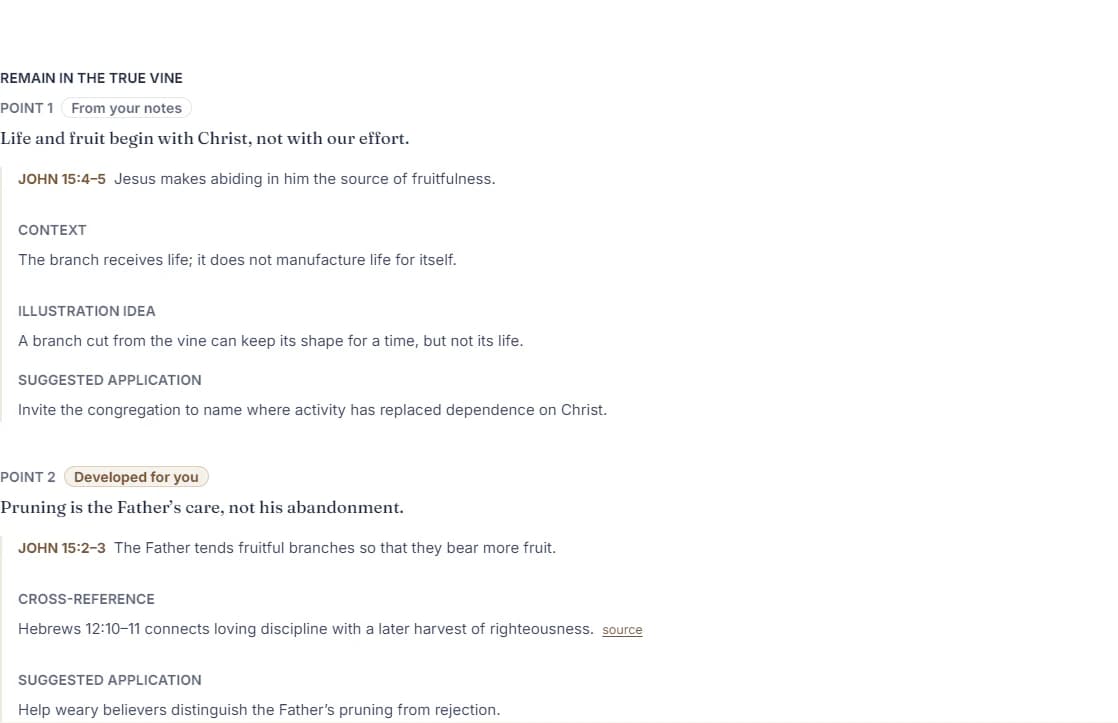
The goal is less repeated work, not a more mechanical church. Scripture, theology and the final call stay exactly where they belong. Read the broader AI guide for the wider questions around church use, boundaries and human responsibility.
Common questions about sermon-linked teaching material
Can I start with rough sermon notes?
Yes. First turn them into a message brief and confirm what they mean. Separate settled points from reminders, questions and possible illustrations. An unfinished phrase is something to clarify, not permission to invent the missing teaching.
What about people who missed the sermon?
Make the session self-contained. Include the passage, a short explanation of context and the teaching centre. Ask questions people can answer from the text in front of them, not from remembering the preacher’s third point.
Can children learn from the same passage?
Yes, when the passage and teaching aim fit their ages and needs. Choose understandable language, manageable reading and concrete activities. Retain the passage’s meaning and reason for responding rather than reducing it to a rule about behaving well.
How should the youth version be different?
Let teenagers examine motives, objections and realistic choices. Use questions that invite reasoning from Scripture. Do not assume slang makes material appropriate, or that personal disclosure proves a discussion has gone deep.
Should we stop using our existing curriculum?
No. Review how sermon-linked sessions fit your wider teaching plan. They may suit a particular series or occasional session without replacing the sequence, breadth and continuity you have already planned.
Can AI help prepare these resources?
It can assist with drafting, alternative questions and adaptations, as long as every addition is visible and a person reviews the result. Follow your church’s policy on what material may be used. For the broader questions, see AI for Churches: Practical Uses and Clear Boundaries.
Is Pastorly required?
No. The method depends on an agreed message brief, appropriate adaptations and responsible reviewers, not a particular tool. Start with one group and a shared document, then decide what support your preparation process needs.
Sources
- Youthworks, How to effectively align your children’s ministry curriculum (Part 1)
A practitioner account from one church describing shared passage and central teaching across children’s settings. It is an example of alignment, not general causal evidence.
- Logos, How to Write Small-Group Questions
Guidance on locating authority in God’s Word and grounding discussion questions in the biblical text. It does not validate every part of this method.
- SmallGroups.com, What Type of Studies Should We Use?
A balanced discussion of sermon-based curriculum, including shared focus, planning workload, quality and flexibility.
- Pastorly home page
Current public description of Pastorly’s connected sermon, slides and ministry-material direction. Pastorly remains in private preview.
- Pastorly FAQ
Current public explanation of pastor-controlled preparation, Aide, and the distinction between From your notes and Developed for you.