Study the passage with Aide beside you.
Aide, Pastorly’s study companion, sits beside your sermon note. Ask about the passage, read the commentaries and the Hebrew and Greek, and look up the history, while your note stays yours.
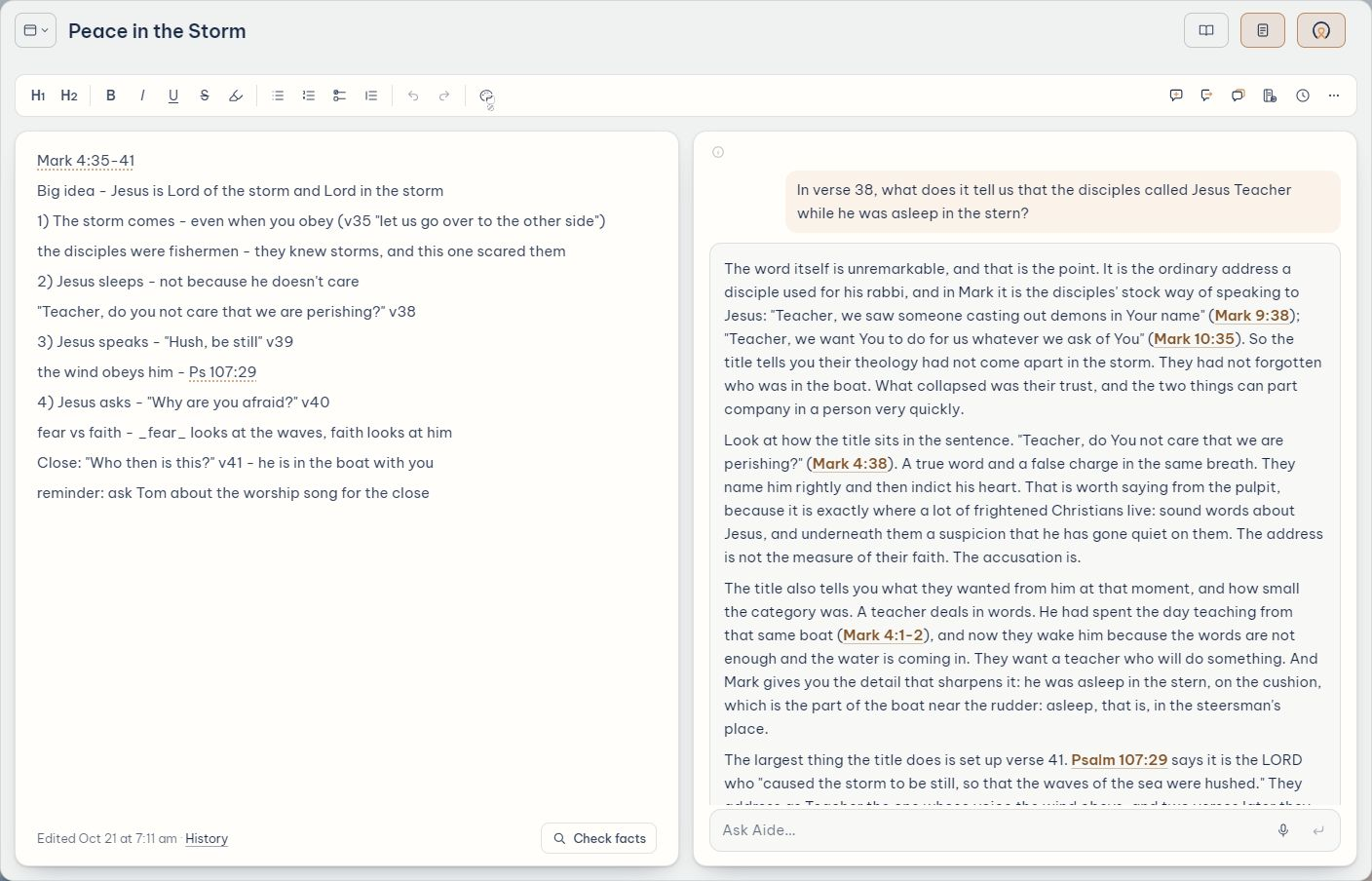
Study the passage with your notes open.
Ask Aide about a verse or a point in your notes.
 AideMark 4:38
In verse 38, what does it tell us that the disciples called Jesus Teacher while he was asleep in the stern?
Aide’s answer · excerptThe word itself is unremarkable, and that is the point. It is the ordinary address a disciple used for his rabbi, and in Mark it is the disciples’ stock way of speaking to Jesus: “Teacher, we saw someone casting out demons in Your name” (Mark 9:38); “Teacher, we want You to do for us whatever we ask of You” (Mark 10:35). So the title tells you their theology had not come apart in the storm. They had not forgotten who was in the boat. What collapsed was their trust, and the two things can part company in a person very quickly.
Look at how the title sits in the sentence. “Teacher, do You not care that we are perishing?” (Mark 4:38). A true word and a false charge in the same breath. They name him rightly and then indict his heart. That is worth saying from the pulpit, because it is exactly where a lot of frightened Christians live: sound words about Jesus, and underneath them a suspicion that he has gone quiet on them. The address is not the measure of their faith. The accusation is.
The title also tells you what they wanted from him at that moment, and how small the category was. A teacher deals in words. He had spent the day teaching from that same boat (Mark 4:1-2), and now they wake him because the words are not enough and the water is coming in. They want a teacher who will do something. And Mark gives you the detail that sharpens it: he was asleep in the stern, on the cushion, which is the part of the boat near the rudder: asleep, that is, in the steersman’s place.
The largest thing the title does is set up verse 41. Psalm 107:29 says it is the LORD who “caused the storm to be still, so that the waves of the sea were hushed.” They address as Teacher the one whose voice the wind obeys, and two verses later they are asking “Who then is this?” (Mark 4:41). So “Teacher” is true, and it is too small for what just happened in front of them. Mark works that way all through: the reader was told in 1:1 who he is, and the disciples spend the book catching up in instalments.
Two things fall out for the sermon. First, they woke the right person, and he did not rebuke them for the title or the terror; he got up, spoke, and then taught them. The teacher’s best lesson that day was not given from the boat, but in the calm. Second, the address they used is the answer they had, and the question they asked at the end is the answer they needed. That is a good place to land a congregation: you may come to him with a true but small word, and he will enlarge it.
Quote Scripture from the Bible you choose.
Aide quotes Scripture from your Bible translation and tells you when a reference does not exist.
What does Mark 4:42 say in the NASB 1995? Please quote it exactly.
Aide’s answer · excerptMark 4 has only forty-one verses; there is no Mark 4:42 in the NASB 1995 or in any other versification.
Read the Bible commentaries you trust.
- Matthew Henry
- The whole Bible
- Adam Clarke
- The whole Bible
- Spurgeon’s Treasury of David
- The Psalms
- Barnes
- The New Testament
- John Wesley
- The New Testament
- Keil and Delitzsch
- The Old Testament
- John Calvin
- Most books of both Testaments
Aide names the commentator behind each reading.
See the Hebrew and Greek behind a word.
Mark 4:38
διδάσκαλεdidaskale
- Meaning
- διδάσκαλος (didaskalos), teacher
- Form
- Noun Vocative Singular Masculine
- Used in
- 58 verses
See what a word means, its form and where else it appears. Read study notes and a Bible dictionary for the world of the passage.
Check the history, with the sources.
Aide looks things up online and shows you the links.
In what year was the ancient Sea of Galilee boat discovered? Give me an authoritative source I can open, and distinguish what is known from what is uncertain.
Aide’s answer · excerptThe year is 1986, and that part is not in doubt. What is worth separating out is the month, the dating, and the label.
The museum dates the discovery to January 1986. That date does not identify the boat as the boat in Mark 4.
Read the museum’s accountChange direction and keep your points.
I am dropping the Teacher point. Help me connect the sermon around fear and faith instead. Keep my four points and do not rewrite the note.
Aide’s answer · excerptThe thread you want is already in your fourth point. The work is to let it run backwards through the first three, because Mark has been building a fear-and-faith argument the whole way across the lake, and the storm is the classroom.
Nothing goes into your note unless you choose it.
Write and keep your sermon notes in Notepad.For the pastor who studies before preaching.
- You study the passage in a busy week.
- You lead a Bible study and want the background ready.
- You want the commentaries without a full shelf.
Read How to Check an AI Bible Answer Before You Teach It and AI for Churches: 12 Practical Uses and Clear Boundaries.
Your sermon stays yours.
- Pastorly works from your own notes.
- Anything Pastorly adds is marked until you approve it.
- Scripture comes from the Bible translation you choose.
- Pastorly follows your church’s tradition.
Sermon preparation and Bible study questions.
Can AI help with sermon preparation?
Yes. Aide studies the passage with you, beside your sermon notes: the commentaries, the Hebrew and Greek, and the history behind the text. What you preach stays your decision.
Which Bible commentaries does Aide use?
Matthew Henry and Adam Clarke on the whole Bible, Spurgeon’s Treasury of David on the Psalms, Barnes and John Wesley on the New Testament, Keil and Delitzsch on the Old Testament, and John Calvin on most books of both Testaments.
Can I use Aide for Bible study as well as sermons?
Yes. Ask about any passage, read the commentaries and study notes, and look at the Hebrew or Greek behind a word.
How does Aide quote Scripture?
From the Bible translation you choose, with the translation named under each quotation. When a reference does not exist, Aide tells you.
Does Aide see my sermon notes?
Yes. Aide reads the note you have open, so you can ask about a line or a point.
Bring the passage you are preaching.
Scripture quotations taken from the (NASB®) New American Standard Bible®, Copyright © 1960, 1971, 1977, 1995 by The Lockman Foundation. Used by permission. All rights reserved. www.Lockman.org