

By Sunday morning, the volunteer preparing the slides may already have chased an email, checked several Bible references and rebuilt an announcement that changed on Saturday. The roster records one name beside one job. At home, the same job can occupy parts of three evenings.
Something similar happens around a children’s lesson, a worship rehearsal or a church lunch. Someone remembers what is missing, follows it up and gets it ready. They become the person everyone trusts to make it happen.
That trust is a good thing. Churches depend on people who love the congregation enough to do work others barely notice. The difficulty begins when their willingness becomes the answer to every new need, and nobody sees the commitments gathering around them.
This deserves attention even where volunteering is recovering. Hartford Institute for Religion Research reported in April 2026 that regular volunteering in US congregations had returned to pre-pandemic levels. That is encouraging, but participation rates do not show how the work is shared within a particular church.
The work between the jobs
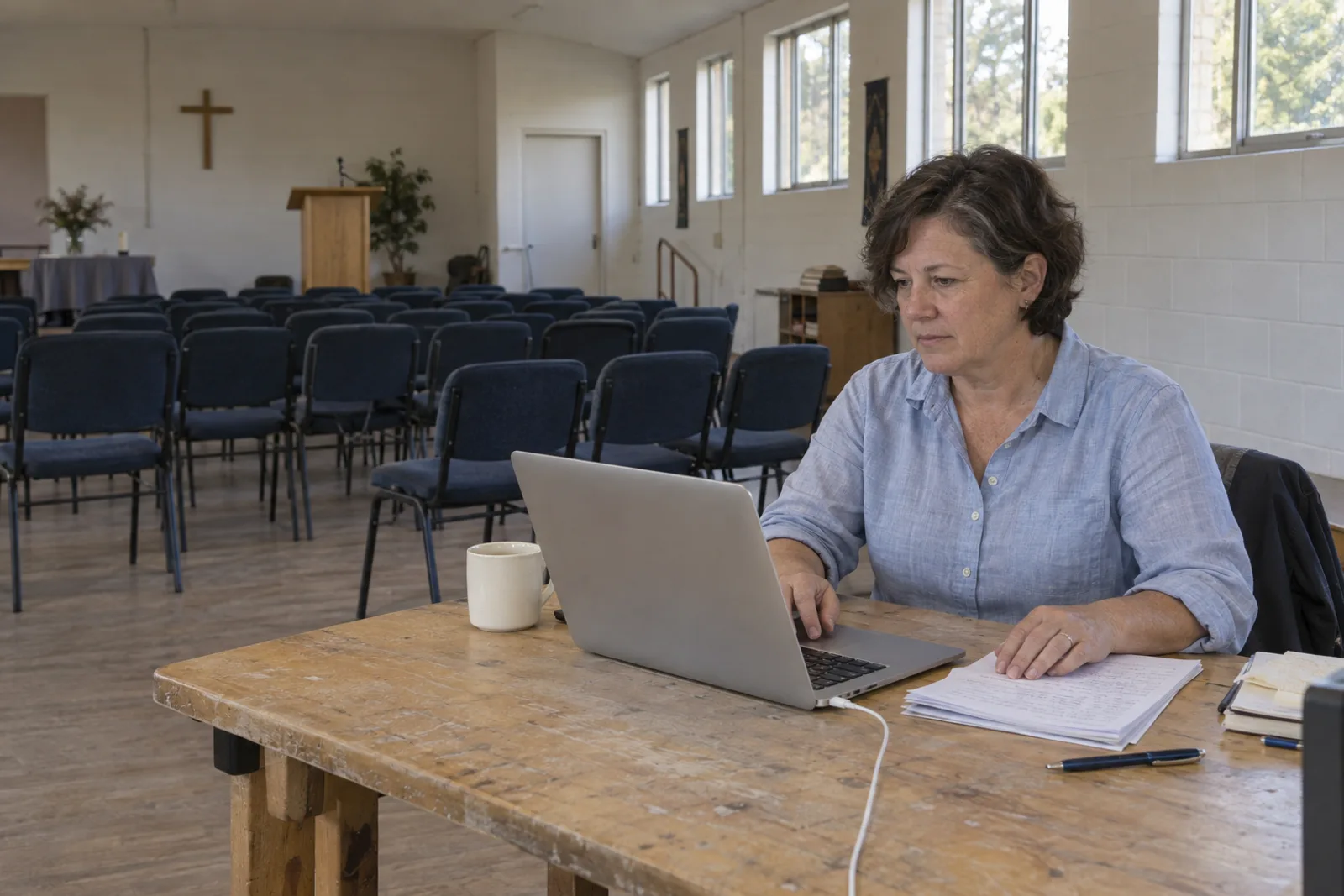
In this illustrative example, a volunteer at a small church prepares the projection material and operates the screen twice a month.
During the week, they collect notices, correct incomplete details, find pictures and send drafts for approval. On Sundays off, they answer questions from the person at the computer. When the laptop needs an update, everyone assumes they will handle it.
Two people take turns at the screen. The preparation and troubleshooting still belong to one person.
What the roster records, and what it does not
The same role, across the rest of the week
- 01PreparationCheck the references and build the service file.
- 02CoordinationCollect notices, chase missing details and get them approved.
- 03TroubleshootingHandle software updates and whatever fails on the day.
- 04AvailabilityAnswer questions, including on the Sundays they are not rostered.
The same distinction matters elsewhere. Leading a Bible study includes preparation and conversations afterwards. Organising a meal includes finding out who needs food, arranging delivery and checking that someone has followed through.
The Malphurs Group’s guidance on volunteer responsibilities recommends defining commitments and revisiting them with volunteers. A useful question is whether the person’s responsibilities still resemble what they originally agreed to carry.
How do you tell if a volunteer is carrying too much?
Counting roles cannot answer it. Someone may enjoy several small commitments and have room for them. Another person may find one demanding role difficult alongside work or caring responsibilities. The person doing the work needs a voice in the assessment.
There is also something heavier than hours: being the person who cannot be away. Genuine cover means someone else can find the materials, make ordinary decisions and complete the work without repeatedly calling the person taking a break.
Make one person’s week visible
Begin with a conversation outside the rush around a service. Ask the volunteer to describe the last few weeks, including the work done from home.
Look across roughly a month to include both weekly and monthly duties. Then add occasional or seasonal responsibilities that the month would miss. The sheet below gives that conversation a simple shape.
Who carries the work?
A conversation about one church responsibility.
- Agreed responsibility
What did the person originally understand the role to include?
- Work across a usual month
Include preparation, attendance, messages, travel, follow-up and unexpected requests. Add occasional or seasonal duties. Estimate time if helpful.
- Support and cover
Who can complete the work in their absence? What materials, access, training or decision-making authority do they still need?
- The volunteer's view
What do they value? What has become difficult? What commitment is realistic now?
- Agreed change
Which task will be shared, simplified, rotated, paused or stopped? Record who arranges it, who takes it on and when the change begins.
- Review date
When will you check that the change happened and that the arrangement works for everyone involved?
Approximate time is enough. Private circumstances need not be recorded.
Keep the discussion proportionate. Volunteers do not need to account for every minute or explain private circumstances to justify a limit. They need room to describe the commitment honestly and agree on something workable.
What should a church do when the same few people do everything?
Start with one responsibility rather than the whole roster. For the projection volunteer, the review might reveal that operating the screen is the part they enjoy. Chasing notices throughout the week is the part they want to relinquish. Recruiting another screen operator would leave the main difficulty untouched.
Ministry leaders could agree to submit complete notices in a shared format by Thursday. A coordinator would compile what arrived and flag missing information once. The people submitting notices would remain responsible for getting the details right.
The service leader would decide what to do with incomplete or late items. Urgent pastoral information may still need adding. A routine announcement could wait or be spoken briefly during the service. That decision would no longer fall to whoever happened to be at the projection desk.
To make room for training, the church could use a simple announcement template for the first month. The experienced volunteer would agree to a practice session with a second preparer and a limited number of reviews.
Before the coordinator or second preparer takes on the work, check their existing commitments and agree what they can carry. Something else may need to stop to make room.
The church would also agree who handles software updates and technical faults, and how the duty team should continue if projection fails. Record when the changes begin, then bring everyone involved into the month-end review.
The same name, four times
At that review, ask concrete questions. Were the notices complete? Did the second person prepare a file? Was the original volunteer able to be away without being called back into the task? Did the coordinator’s work stay within the commitment they agreed to?
An arrangement that exists only on paper needs further work.
Give others responsibility they can carry
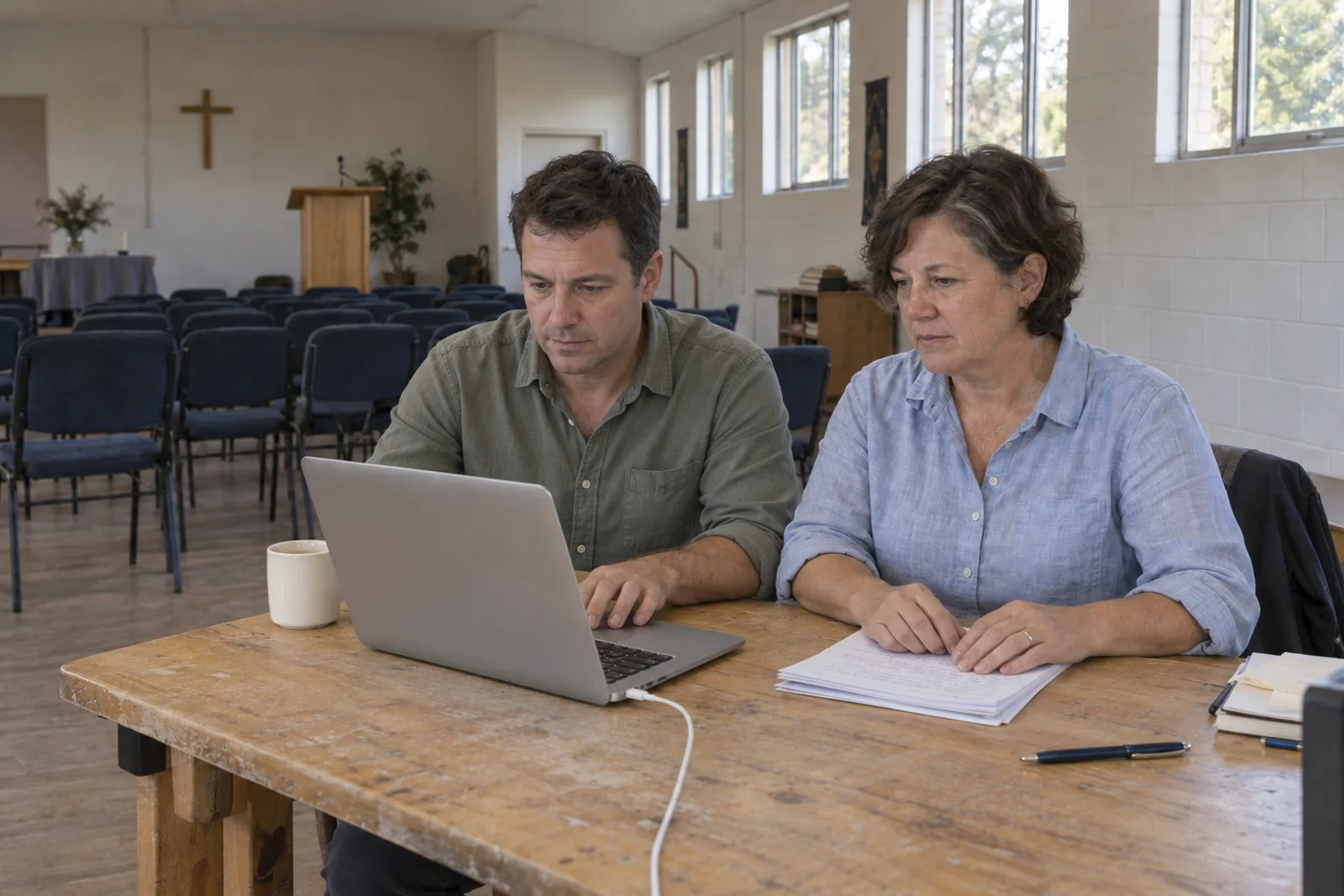
How do you hand over a church role?
A folder, a short walkthrough and a chance to practise can make the difference between a willing helper and someone ready to take responsibility.
The handover should explain what matters most. For slides, that might mean accurate Scripture, readable text and the right order. A new volunteer also needs to know which decisions they can make themselves. Requiring permission for every choice leaves the original person supervising from a distance.
Teaching ministries need particular care. Leaders should consider a person’s character, understanding of Scripture and readiness for the responsibility. A new Bible study leader needs time to understand the passage, the intended direction and where difficult questions can be taken. Give them material early enough to study it. Our guide to preparing Sunday School, small-group and youth material from one sermon explores that part of the work.
There is a biblical reason to take this seriously. In Ephesians 4:11–16, Christ gives leaders to equip his people for ministry, with the body growing towards maturity in him as its members contribute. Church leaders have reason to develop others’ ability to serve.
This takes patience. The first shared attempt may need correction. A sensible handover allows someone to learn while maintaining the standards the work requires. Expecting a new volunteer to match ten years of another person’s experience immediately makes for a difficult entrance.
Recruitment can be concrete too. “Help with church communications” sounds open-ended. Preparing notices for two Sundays, with a template, a named person to ask and an agreed review, is a commitment someone can understand. Describe the preparation as well as the visible duty.
Some work needs to become smaller
There will be times when the available people cannot sustain everything on the calendar. That calls for a decision about the work itself.
A congregation might offer a simpler meal, use a familiar lesson format or stop making a fresh promotional image for every gathering. A meeting may need to happen less often. Reducing unnecessary preparation can preserve an activity’s purpose while making the commitment manageable.
Is it right to stop a church activity because nobody can run it?
Some activities are valuable enough to protect or fund properly. Others have continued because they worked well in an earlier season. Ask what the congregation would lose by changing them, who would be affected and whether the benefit still warrants the work. Those questions belong with leaders who can make the decision.
Writing about his own church commitments, writer and church volunteer Michael Perera describes the difficulty of stepping back. He recognises that some activities may happen less often or end. His account captures why permission to step back can feel incomplete while everyone still expects the work to appear.
A volunteer who has asked for a change should know what has been agreed and when it begins. Leaving them in place until an unspecified replacement appears can make an honest conversation feel pointless.
Room to belong
The congregation’s care for that person continues beyond their usefulness. They should be able to join worship, receive teaching and enjoy relationships without every conversation becoming another request. The church is the community to which they belong.
First Peter 4:10–11 calls believers to use their gifts in service to one another, relying on the strength God supplies. It honours willing service and directs it towards the good of others and the glory of God. It gives no reason to treat one person’s availability as unlimited.
For a church recognising this pattern, the next step can be small. Choose one responsibility that has grown difficult to carry. Sit down with the person doing it. Write out the work, agree on a real change and return to it in a month.
By then, another member may be ready to prepare the service file. The notices may arrive complete. The volunteer may have spent their Sunday off sitting with their family. Those are changes a church can see, and they begin with taking someone’s account of their week seriously.
Sources
- Hartford Institute for Religion Research, Congregational attendance rises for the first time in 25 years
Reported April 2026, from a survey of 7,453 US congregations across 79 denominations and traditions. It supplies the participation context only. It says nothing about how work is divided inside a particular church, and nothing about Australia or New Zealand.
- The Malphurs Group, Volunteer burnout in churches
Practitioner guidance on defining volunteer responsibilities and revisiting them. No prevalence estimate is taken from it.
- Michael Perera, Burnout among church volunteers, Faith+Lead
One writer and church volunteer describing his own commitments. An individual account, not representative research.
- ESV, Ephesians 4:11–16
Christ gives leaders to equip his people for ministry. Paraphrased in the article, with the application stated as application.
- ESV, 1 Peter 4:10–11
Believers serving one another with their gifts, in the strength God supplies. Neither passage is presented as prescribing a particular staffing arrangement.